
Closing ceremony of the Athens 2004 Olympics
The closing ceremony of the Olympic Games was a great Greek celebration for the whole world.
Home > Athens > History and Archaeology > Olympic Games > Greater Athens > Closing ceremony of the Athens 2004 Olympics
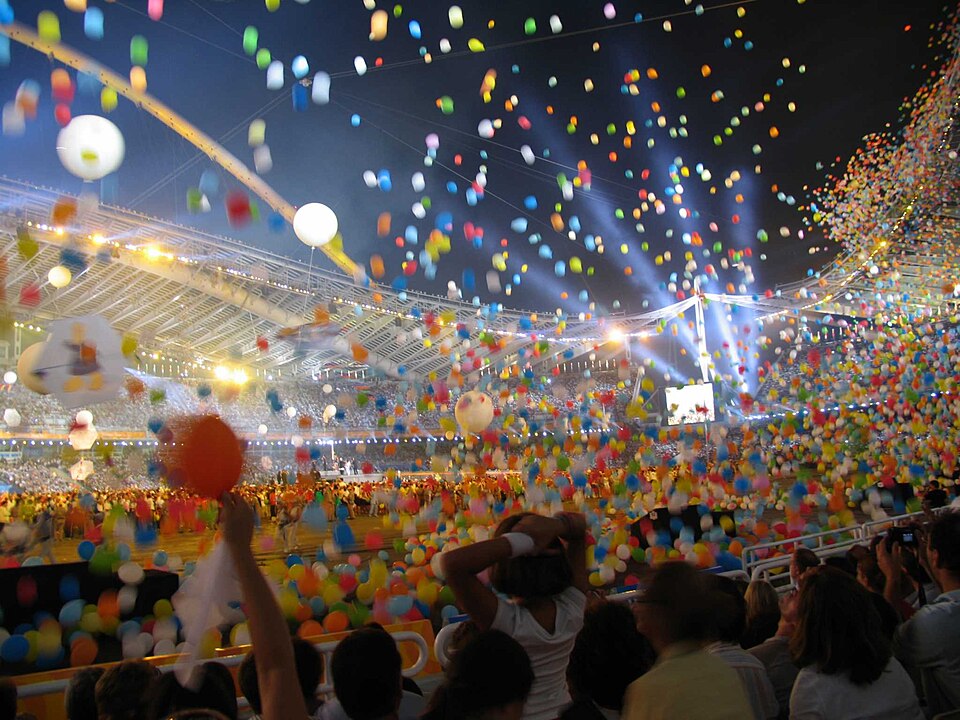
What I can see
Under the gaze of the August full moon, everything is ready for the closing ceremony of the Athens Olympic Games. At the centre of the stadium there is a runway and a giant spiral of wheat runs through it. Wheat symbolizes Mother Earth and rebirth. The countdown begins with heartbeats, just as the opening ceremony had begun. In this case, the heartbeats are those of the athletes and spectators’ anxiety, joy and disappointment, as depicted on the stadium’s video walls with snapshots of the games, reminding us of the variety of intense emotions they cause.
The ceremony begins with the artistic part and the high priestess Thalia Prokopiou welcomes us to the closing ceremony of the games of the 28th Olympiad. The ceremony is a Greek feast from all parts of Greece, from places where the Greek element has been strong and the invitation is addressed to all humanity. That is why the State Orchestra of Greek Music, conducted by Stavros Xarhakos, plays “As Kratisoun i Hori” (Let the Dances Last) by Dionysis Savvopoulos and sung by 5 of the country’s top singers: Haris Alexiou, Dimitra Galani, Marinella, Giorgos Dalaras, Yiannis Parios. The volunteer- performers, dressed in traditional costumes, encourage spectators to celebrate together and this immediately happens. The climax is the moment when the entire stadium takes out their white scarves and waves them to the rhythm of the music. The scarf is a very common and useful object in Greek dances. It was also used in difficult farewells, such as for people who emigrated or traveled and perhaps never returned. In a similar way, Athens bids farewell with emotion to the Olympic Games and the people who gave them life.
Afterwards, the emblematic singer of Thrace (N.E. Greece), Chronis Aidonidis, invites us to the table to eat altogether, while the first reapers gather the first ears of wheat. Performers have gathered at the entrance where the Koudounofori or Koudounati of Sochos, Thessaloniki enter, figures dressed in heavy costumes with very heavy bells hanging from them. The roots of Greek carnival date back to antiquity and the god Dionysus. Over the centuries, unique customs developed in each place, but their common element was to send away evil spirits through very loud noises, sounds that break the silence of death and nature is reborn. The same symbolism applies to Greek Easter with firecrackers and fireworks, the passage from death to resurrection. Then, Tsestos dance begins, a dance from Eastern Rumelia (present-day southern Bulgaria), where many Greeks lived until the end of World War I. Tsestos dancers are on the runway and at the 4 corners of the stadium. In the meantime, the reapers reap the wheat and women with pitchers come towards the centre of the runway.
With the change of musical theme, winemakers – as Dionysian figures, since Dionysus was the god of wine and festivities – melt the grapes and produce wine to begin the feast. Tsamikos is the dance that is danced in most traditional feasts of mainland Greece, a war dance of Epirus (N.W. Greece) and a traditional dance of neighbouring Albania, a proof that culture in the wider region pre-exists and transcends modern borders. Tsamiko is danced by tsoliades, whose foustanella (kilt) consists of 400 pleats, symbolizing the 400 years under Ottoman rule. At the same time, on tables with white cloths, the months of the year stand as male figures, reminiscent of works by the painter Yannis Tsarouchis, an artist ahead of his time that scandalized the then ultra-conservative Greek society.
A wedding is held and women dance the Tsakonian dance of the Peloponnese (S. Greece). Underage girls were “destined” for marriage, the dark side of tradition, but also the only way out of poverty. Marriage, however, is always considered one of the happiest events even these days, which is why wedding customs are countless throughout Greece. Next to the newlyweds, women of the village knead to the rhythms of Kalamatianos dance (Peloponnese, S. Greece).
How could Greek summer be missing from the closing ceremony? The table cloths on which the months stood, suddenly rise like ship sails, creating a Cycladic setting, with Yiannis Parios singing and the dancers dancing Balos. On the runway, fishermen unfurl their nets, windmills spin and bathers move rhythmically to the music from these islands. Everyone’s attention is drawn by the entrance of a farm vehicle with watermelons and the Greek Roma dancing tsifteteli, a social group that is still quite marginalized. Tsifteteli dance has its roots in the eastern parts of the Byzantine Empire (areas of present-day Turkiye) and the Middle East. Today, it is one of the most common dance rhythms of Greek folk music. Marinella sings the famous tsifteteli “Anapse to Tsigaro” (Light the cigarette), while customers of bouzouki stages, with bright clothes, hair colour and makeup dance on the tables, an image that indicates the ceremony creators’ sarcastic mood, but at the same time, the representation is accurate.
The atmosphere changes with a tribute to the people of Greek cinema and theatre; Dimitra Galani is singing “Manoula mou” [My adorable mother] by Manos Hatzidakis, a song that talks about the heartbreaking separation of a mother from her child, either due to migration or due to death. The volunteer performers approach the centre of the stage, while the wheat harvesting is continued. The young couples on the runway wrap themselves with the figures of the artists and move towards the future. Suddenly, a spiral galaxy is formed and a moon flies over the stadium. The moon is a source of inspiration for many songwriters. The galaxy unfolds and a dreamlike setting is created with the soulful voice of Haris Alexiou and under the August full moon.
This is followed by a tribute to rebetiko music, which was brought by the Greek refugees of Asia Minor (present-day Turkiye) after the Greco-Turkish war. Fires are lit at the 4 corners of the stadium and dancers jump ecstatically over them. Fire dancing exists in many regions of Greece as a traditional custom. A series of rebetiko and Tsarouchis figures are on the runway, reminiscent of interwar Greece, as is the case with the tsolias on the bicycle, chased by the gendarme.
The music changes and comes from Crete (S. Greece). The instrumentalists on the runway and the dancers at the 4 corners play and dance respectively to the rhythm of the Maleviziotis or Maleviziotikos dance, while the reapers now gather the cut wheat into bundles. After the Maleviziotis, we are transported to Pontus (present-day north eastern Turkiye) and the Pyrrihios dance, one of the most impressive war dances, with roots in ancient Greek mythology. After the Pyrrihios, comes the Amanes, a cry of pain and anguish, asking for mercy, like that of Greek refugees of Asia Minor. Amanes has its roots in the Byzantine era and the regions of Anatolia and the Middle East. With the population exchange of 1923, almost 2 million Greeks arrived in Greece, leaving their ancestral lands forever. On the runway, people are hunched over, suffering and in pain. But these people did not give up hope. They got up, stood on their feet and the caravans of refugees on the runway are transformed into a giant table with many goodies and everyone is invited. The song “Mana mou Hellas” (Mother Greece) speaks of the pride of modern Greeks for the ancient past, but of their indifference to the present and the steps they must take towards progress.
The artistic part is coming to an end and the notes that Greece is known for worldwide could not be omitted. Zorbas by the Oscar-winning Mikis Theodorakis was the soundtrack to the film Zorba the Greek. The reapers have gathered all the ears of wheat in bundles, put them on their shoulders and run to the rhythm of Zorbas. On the runway, the table has evolved into a big feast, which is also joined by tourists. At the climax of Zorbas, the reapers form the Olympic rings with the ears of wheat.
The ceremony continues with the medal ceremony for the men’s Marathon (for the first time in a closing ceremony and a gold medal for the Italian Stefano Baldini), the parade of nations with flags on the runway and the entry of the athletes into the venue without being positioned by country, as if they are a large group of friends. Speeches are delivered by the president of the Athens 2004 organizing committee, Gianna Angelopoulou Daskalaki, and the president of the International Olympic Committee, Jacques Rogge, who describes the Athens Olympic Games as “dream games”.
After the playing of the national anthems of Greece and China, the mayor of Athens, Dora Bakoyannis, accompanied by the brass band of Kozani (northern Greece), hands over the Olympic flag of Antwerp to the mayor of Beijing (the next organizing city) Wang Qishan. This is also the moment when the stadium and the viewers get a first taste of the Beijing Games, with a ten-minute artistic performance that includes elements of Chinese tradition and ultimately invites us to Beijing for the 2008 Games.
Then, the Olympic flag is lowered, the Olympic cauldron “bows” to human again (as in the opening ceremony) so that the light can be transferred throughout the stadium by children. With a puff of air from a little girl, the flame goes out, an emotional moment for the Greeks.
Every end is also a new beginning and Greece says “until we meet again and so long” in the most musical way. Under a “rain” of fireworks, Dionysis Savvopoulos, Eleftheria Arvanitaki, Alkistis Protopsalti, Anna Vissi, Michalis Hatzigiannis, Antonis Remos and later Sakis Rouvas sing “Aeroplana ke vaporia”, “Dynata dynata”, Mysirlou (a traditional song known worldwide thanks to its adaptation for the Pulp Fiction soundtrack), “Ta pedia tou Pirea” (Oscar for Best Song for the film “Never on Sunday”) and many Greek classic and newer hits of the second half of the 20th century and the dawn of the 21st century.
What I can't see
The artistic director of the ceremony was the world-famous Dimitris Papaioannou, the music editor was George Koumendakis and the director of the first artistic part was Thomas Moschopoulos.
The closing ceremony was not loved by the Greeks at that time as much as the opening ceremony, and this is because, on the one hand, there were failures in the television direction, on the other hand, it portrayed an honest face of modern and contemporary Greece, which perhaps caused embarrassment to those who wish a more “sterile” image of Greece to be broadcast. Over the years, however, this “uncomfortable” condition for some people subsided and now everyone is talking about a closing ceremony that embraced all Greeks and the world. It was also a ceremony in which parallel events were taking place, a bold directorial move that left no room for boredom for the viewers. Ticket prices for the ceremony started at 50 euros and went up to 750.
There could not have been a better coincidence than the Athens Olympics to be followed by the Beijing Olympics, 4 years later. From the games that celebrated human and its unique nature, to the games where the individual is less important and collectivity is prioritized, an excellent semiotic “dialectic” between two great cultures.
You can see the Athens 2004 Olympics Closing Ceremony here:
Bibliography
Olympic Channel, Athens 2004 Closing Ceremony- Full Length| Athens 2004 Replays
https://www.youtube.com/watch?v=a5yg3XHae_0&t=22s
Last visit 19/3/2026
Kyriakou Z., (2003), Ολυμπιακοί Αγώνες, η γέννηση, η αναβίωση, η επιστροφή, [Olympic Games, the birth, the revival, the return], Dimosiografiki Epitheorisi, Taxideftis
Location
Timeline
Modern and Contemporary era (1821 - )
2004 The ceremony took place on the 29th of August.

Share