
Opening ceremony of the Athens 2004 Olympics
The opening ceremony of the Athens Olympic Games set new international artistic standards.
Home > Athens > History and Archaeology > Olympic Games > Greater Athens > Opening ceremony of the Athens 2004 Olympics
What I can see
All is set in the Athens Olympic Stadium (OAKA) for the biggest sporting celebration. The “bold” stage, on which the artistic program of the ceremony will take place, is an artificial lake that took many hours to fill with water. The countdown begins with a common sound for all humanity, the heartbeat. Drummers enter the stadium, beating the drums to the rhythm of the heart. The high priestess of the Olympic flame, Thalia Prokopiou, welcomes the citizens of the world to the celebration of Athens and makes everyone emotional with the phrases “Olympic Games welcome home, welcome back to Greece”.
The ceremony begins with the “Zeibekiko of Zeus” by Stavros Xarhakos, a rhythm that is an integral part of the modern Greek musical tradition and symbolizes the union of spirit with body and of the divine with matter. The drummer of the ancient stadium in Ancient Olympia, birthplace of the ancient games, is having a “dialogue” with the drummer of the Athens stadium as if their heartbeat becomes stronger and stronger. At the climax of these beats, the flame from the ancient stadium of Olympia comes to Athens, falls into the water and lights the five Olympic rings, symbol of the 5 continents and the Olympic movement.
Then, a little boy sails on the water in a paper boat, symbolizing the centuries-old maritime tradition of the Greeks. At the same time, the Navy band musically accompanies the little boy, with the melodies of the Oscar-winning composer Manos Hadjidakis. This was followed by the raising of the Greek flag and the acapella singing of the national anthem of Greece by a male choir.
The second chapter of the artistic part of the ceremony begins with the actress Lydia Koniordou holding a marble head of a statue, while the high priestess recites verses by the Nobel Prize-winning poet, George Seferis. A centaur, a mythical symbol of the conflict between human civilization and man’s animal nature, throws his spear at the centre of the stadium and one of the first forms of high art (5000 years old), the Cycladic statuette, emerges from the water. Reflections and achievements of ancient philosophers, who largely determined world thought are projected on its surface. Then, the statuette breaks and the kouros (son) of the archaic era emerges, a radical era, during which statues acquired movement. With the kouros’ breaking into pieces, the heyday of art emerges, that of the classical era, during which the human form, movement, emotions and passions are depicted in perfection. With the breaking of this sculpture too, all the pieces float in the stadium like celestial bodies floating in space, where we come from and where man has always sought answers. Thus, from metaphysics and myth, man passes to logic and science, as symbolized by a rotating cube in the centre of the stadium, on which he walks. The floating bodies take a vertical position and become canvases of images of the diversity and multifaceted nature of man. Finally, with the musical climax and the end of the projections, the floating members land haphazardly in the water, just like the islands of the Aegean Sea.
The third part of the artistic section has Eros as its central protagonist. Eros (love) is the driving force for everything. The Greeks were the first to personify love and in the course of human history, Eros goes in the opposite direction, shaping it. Thus, Eros goes against the course of the “Klepsydra [Hourglass in Greek]” (music by Konstantinos Vita), a timeline of Greek culture and art, from Minoan Crete and the Cyclades (3500 BC) to the present day. During the Klepsydra act, it is worth noting the Parthenon sculptures of the classical era that slowly place their pieces on them, as a silent protest for the reunification of the Parthenon sculptures, since many of them are in the British Museum. The timeline is completed with the fruit of love and a pregnant woman, who brings hope for the future. She walks towards the water accompanied by the unique voice of Maria Callas and a galaxy is formed in it. The galaxy gradually acquires a three-dimensional shape and at the end, the double helix is formed, around which all the performers of the ceremony gather to admire one of the top achievements of science, the decoding of DNA.
The creative part of the ceremony comes to an end with the “Asteri tou Voria” [North Star] by Nikos Gatsos and Manos Hadjidakis. The water in the lake empties in a few seconds, the parts of the sculptures rise and float again and, directed towards the centre of the stage, form a mountain, on top of which grows an olive tree, a symbol of peace and a symbol of the myth, according to which, goddess Athena threw her spear into the rock of the Acropolis and the sacred olive tree sprouted.
The athletes are welcomed with the Greek flag entering first, followed by all the countries in alphabetical order, according to the Greek alphabet, and under the musical production of DJ Tiesto. The athletes’ parade ends with the entrance of the Greek team. Approximately 10,000 athletes are gathered in the centre of the stadium, among them Kelly Holmes, Liu Xiang, Birgit Fischer, Michael Phelps, Carly Patterson, Usain Bolt, Pyrros Dimas and many more.
The stadium lights fade out and Bjork’s voice is heard. The Icelandic singer sings Oceania, a satellite connection with the International Space Station and a tribute to the revival of the games, thanks to Pierre de Coubertin and Dimitrios Vikelas, follow. A track and field athlete (and later folk- pop singer) runs around the stadium cutting ribbons, each of which represents a modern Olympiad. After the 1912 Stockholm Olympics, the athlete falls to the ground and spectators react as in shock. The fall is a reference to the outbreak of World War I, during which the games were not held.
Afterwards, under the sacred olive tree, speeches are given by the president of the Athens 2004 organizing committee, Gianna Angelopoulou Daskalaki, and the president of the International Olympic Committee, Jacques Rogge. The President of the Hellenic Republic, Konstantinos Stephanopoulos, declares the games open and the stadium welcomes the Olympic flag, which is then placed next to the Greek flag, while the Olympic anthem is being sung. After the oaths of athletes, judges and coaches, a sphere of concentric rings with the names of cities from all over the world and flying torchbearers heading towards it, portray the journey of the flame, which -for the first time- traveled to all continents.
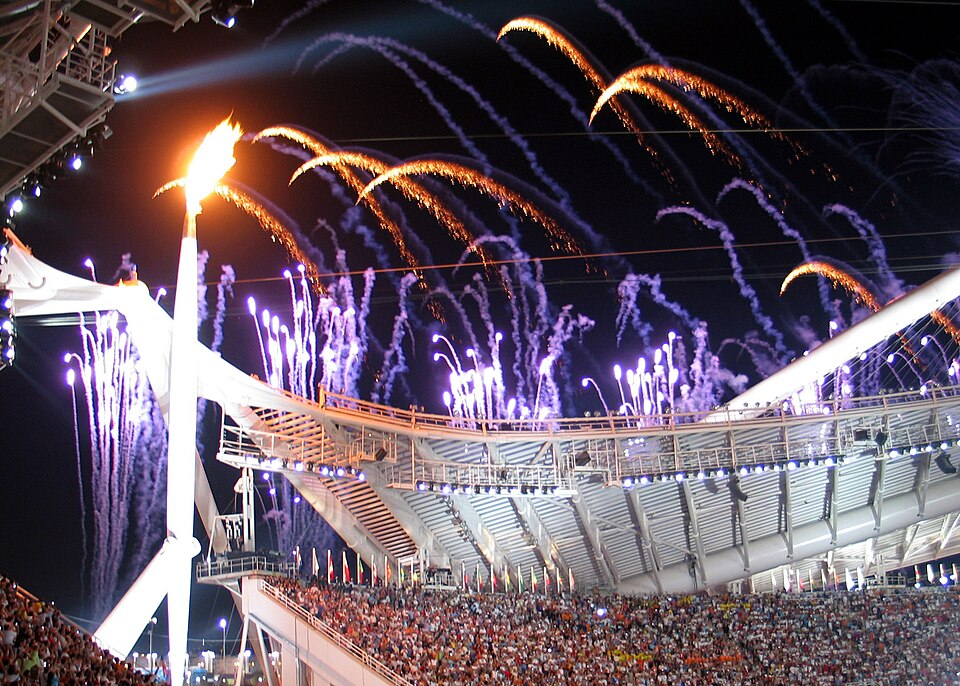
Nikos Gkalis enters the stadium with the Olympic flame. After a series of prominent Greek Olympians, the athlete to light the cauldron is the gold medalist Nikolaos Kaklamanakis. The cauldron has the shape of a torch and is also reminiscent of an olive leaf. The cauldron has already “bent” towards the athlete, a symbolic image of the need for technology to bow to man and not the other way around. With the lighting of the flame, the cauldron returns to an upright position and illuminates the stadium. The Athens Olympic Games are now a fact.
What I can't see
The Athens Olympic Games opening ceremony was the first to be broadcast in HD. The lighting director for the ceremony, Eleftheria Deco, won an Emmy Award in 2005 for Outstanding Lighting Direction. If the Greeks are proud of the opening ceremony of the games, it is because the artistic director Dimitris Papaioannou and his team managed, in about 40 minutes (the duration of the artistic part of the ceremony), to condense all of Greece, its history and culture, but above all, this artistic creation has been an ode to human and its progress, from antiquity to modern times, from myth to logic, from the search for the macrocosm to that of the microcosm, from our universal insignificance to our genetic uniqueness, from the conquest of the sea to the conquest of the mountain peaks and from Eros (love) to civilization.
Dimitris Papaioannou is a globally acclaimed artist. Director, choreographer, visual artist, student of painter Yannis Tsarouchis and graduate of the Athens School of Fine Arts, he founded the Edafos Dance Group, won many international awards and directed many performances that traveled around the world, such as Medea, Medea 2, Still Life, The Great Tamer, Transverse Orientation, Requiem for the End of Love and many more. Tickets for the ceremony cost from 100 to 950 euros.
You can watch the Athens 2004 Opening Ceremony here:
Bibliography
Dancetheatergr, Δημήτρης Παπαϊώαννου- Βιογραφία, [Dimitris Papaioannou- biography]
https://www.youtube.com/watch?v=iy8gkAJGxOU
Last visit 19/3/2026
Eleftheria Deko Lighting design
https://edeko.gr/el/%CE%B5%CE%BB%CE%B5%CF%85%CE%B8%CE%B5%CF%81%CE%AF%CE%B1/
Last visit 19/3/2026
Olympic Channel, Athens 2004 Opening Ceremony- Full Length| Athens 2004 Replays
https://www.youtube.com/watch?v=YYvnvr8Cpzo&t=2423s
Last visit 19/3/2026
Kyriakou Z., (2003), Ολυμπιακοί Αγώνες, η γέννηση, η αναβίωση, η επιστροφή, [Olympic Games, the birth, the revival, the return], Dimosiografiki Epitheorisi, Taxideftis
Location
Timeline
Modern and Contemporary era (1821 - )
2004 The ceremony took place on the 13th of August.

Share