Makarios III
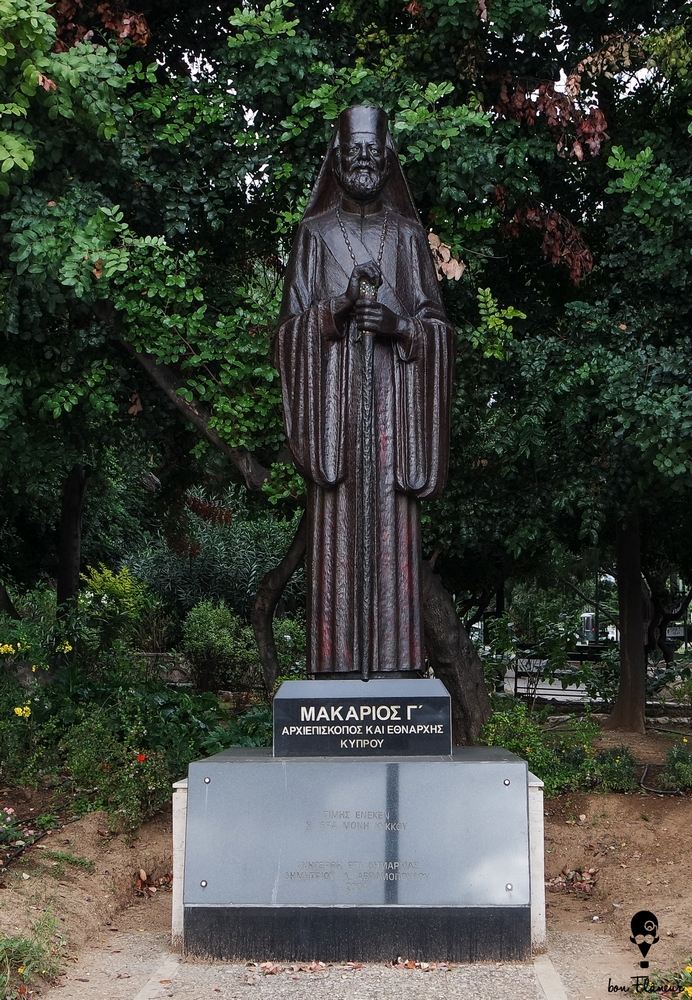
Statue of the president of Cypriot Republic, Makarios the third.
Location
Timeline
Modern and Contemporary era (1821 - )
1987 The original statue was created.

Statue of the president of Cypriot Republic, Makarios the third.
Home > Athens > Culture > Modern art/ sculpture > Centre > Makarios III
This 3.13m high brass statue, a work by Memos Makris, is placed on a stepped pedestal and depicts Archbishop Makarios III in a standing position, in priestly vestments and with a pastoral staff. Makarios looks serious, a reference to the difficult times that he -as president of Cyprus- and the Cypriot people went through.
This sculpture is copy of the original statue located in the presidential palace of Cyprus. It was a donation from the Kykkos Monastery to the City of Athens. Makarios (1913-1977, originally named Michael Mouskos), former bishop of Kition, became Archbishop of Cyprus in 1950, when the island was still a British colony. Together with Georgios Grivas, they founded EOKA and organized the armed struggle to overthrow colonialism, while union with Greece was the ultimate goal. Due to the repetitive hesitation of Greek governments, the refusal of British governments to negotiate, the threat of Turkiye that had interests on the island, but also the fragile Cold War balances, lead the idea of union with Greece to gradually fade out. Makarios lived a turbulent political life; from the founding of EOKA, to his exile in the Seychelles by the British, the internationalization of the Cyprus problem, the independence of Cyprus in 1960, his presidency, the conflicts with the armed Turkish Cypriot organization TMT and the Cold War games of the USA and the USSR in the region. Huge pressure from the Greek dictatorial government of Papadopoulos for union with Greece was put on Makarios and in cooperation with the later Cypriot organization EOKA II, a coup was carried out against him by the next Greek dictatorial government of Ioannides. Terrorist attacks by EOKA II on leftists, Turkish Cypriots and Makarios himself followed. Under the pretext of protecting the Turkish Cypriots, the coup gave Turkiye the opportunity to invade Cyprus during the summer of 1974 and occupy 33% of the island, as is the case to this day. Turkiye’s standing view was that Cyprus should not be united with Greece, nor should it be an independent state, because it would significantly limit its interests in the eastern Mediterranean. After the end of the war, and until his death, Makarios, together with the Turkish Cypriot leader Rauf Denktash, laid the foundations for the resolution of the Cyprus problem on the basis of a federal bizonal state, an issue which remains unresolved to this day, even though Cyprus is a member state of the European Union.
Antonopoulou Z., (2003), Τα γλυπτά της Αθήνας, Υπαίθρια Γλυπτική1834-2004 [The sculptures of Athens, Outdoor sculpting 1834-2004], Potamos
Droussiotis M., (2002), ΕΟΚΑ Β και CIA, το ελληνοτουρκικό παρακράτος στην Κύπρο, [EOKA B and CIA, Greek- Turkish parastate] Alphadi Publications
Thrasivoulou Μ., (2016), Ο εθνικισμός των Ελληνοκυπρίων, από την αποικιοκρατία στην Ανεξαρτησία, [The nationalism of Greek-Cypriots, from colonialization to Independence], Thessaloniki: Epikentro
Rizas S., Stefanidis I., (2003), Το Κυπριακό Ζήτημα, ο αγώνας για ένωση, η ανεξαρτησία, η τουρκική εισβολή, [The Cyprus Problem, the struggle for union, independence, the Turkish invasion], in Ιστορία του νέου ελληνισμού, 1770-2000, [History of modern Hellenism], Ellinika Grammata, v.9, p.p. 97-110
Rizas S., Stefanidis I., (2003), Το Κυπριακό 1974- 2004, οι ατελέσφορες μεσολαβητικές προσπάθειες, [The Cyprus problem 1974-2004, the ineffective mediation efforts], in Ιστορία του νέου ελληνισμού, 1770-2000, [History of modern Hellenism], Ellinika Grammata, v.10, p.p. 51- 62
French D., (2015), Fighting EOKA: The British Counter-Insurgency Campaign on Cyprus, 1955-1959, Oxford University Press.
1987 The original statue was created.
Share