
The Ancient Olympic Games
A visualized journey into the world of the ancient Olympic Games.
Home > Athens > History and Archaeology > Olympic Games > Centre > The Ancient Olympic Games
What I can see
Certainly, we cannot see anything from the ancient Olympic Games, unless we visit archaeological museums, where we can admire vases, sculptures and other objects related to them, or if we visit the archaeological site of Ancient Olympia. However, we can imagine them and create images in our minds.
The games were held in Olympia (western Peloponnese) every 4 years, after the first full moon of the summer solstice, and were of the utmost importance to the Greeks, who flocked from all the city-states of the Greek world, from Sicily to Asia Minor and from the Black Sea to Egypt. Therefore, the heart of Greece beat there for over 1200 years. Athletes and coaches had to be in Olympia a month before the games, to present themselves to the rulers of Elis, to be registered and then train under the supervision of the judges. If they arrived late, they were banned from the games. During that month, something like qualifying games were held, the most capable ones qualified for the Olympic Games and were classified in specific categories. The withdrawal of athletes who had qualified entailed a financial penalty. The responsibility for organizing the Olympic Games was held by the Hellanodics, an office initially hereditary and lifelong, but later elected per Olympiad (the period between the end of the games and the next ones, which served as a measure of chronology for the Greeks, gradually replacing local chronologies). The Hellanodics were usually elected by lot and underwent ten months of intensive training. The assistants to the Hellanodics were the alytarches or alytes (something like sports police), the Rhabdouchoi, the theikoloi (responsible for sacrifices), the oracles, the priests, the woodcutters (for the wood for the sacrifices), the secretaries (for the records), the spondophoroi (messengers of the start of the games and the truce throughout Greece), the explicates (they informed visitors about the events and rituals) and many more volunteers.
The games began with the athletes’ and Hellanodics’ oaths in front of the statue of the Orkios (oath-taking) Zeus, followed by the games and the last day was dedicated to the crowning of the athletes, while 100 oxen were sacrificed in honour of Zeus. At the same time, the sacred truce had already been put into effect, which first lasted one month and later three months. It began with the announcement of the games, and beyond its sacred significance, it ensured the safe arrival of athletes, spectators and others involved in the games in Olympia. During the truce, any hostilities and executions or armed trafficking in the region of Elis were strictly prohibited. Violation of the truce by the athlete or the city also meant their ban from the games.
The athletes were only men, except in the case of equestrian games, in which the owner of the horses – who could be a woman -competed and not the charioteer. The games could be attended by everyone (Greeks, foreigners, slaves), except for -mainly married- women, for whom entry into the sanctuary was permitted after the end of the games. Until then, they were only allowed to watch from a distant hill.
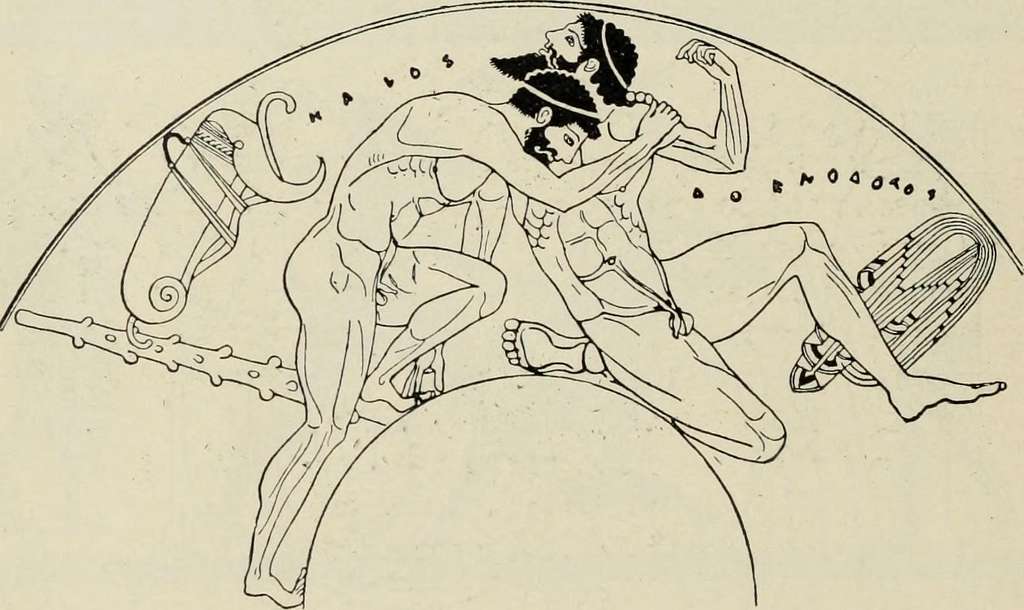
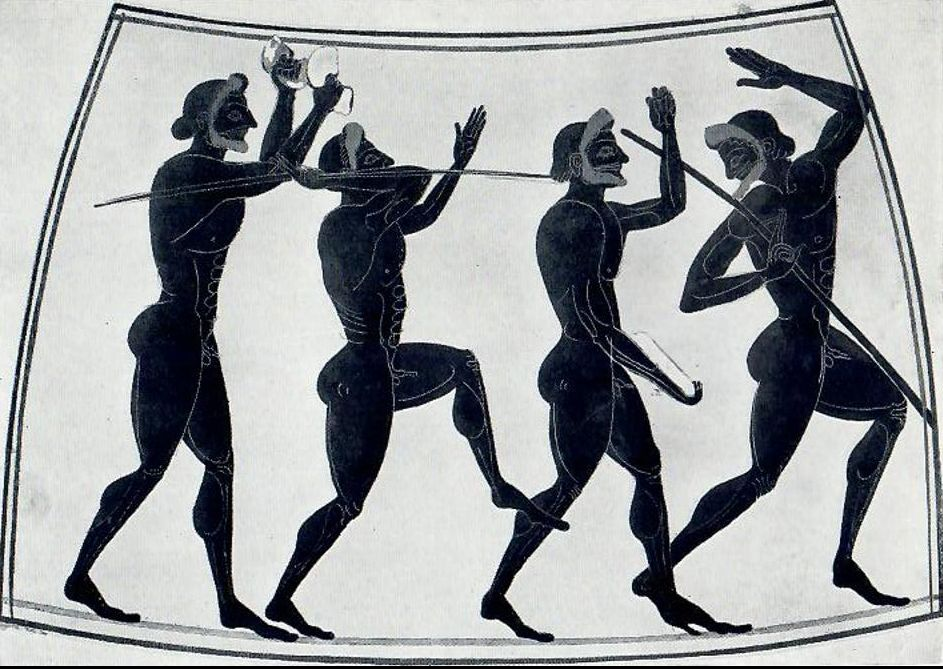
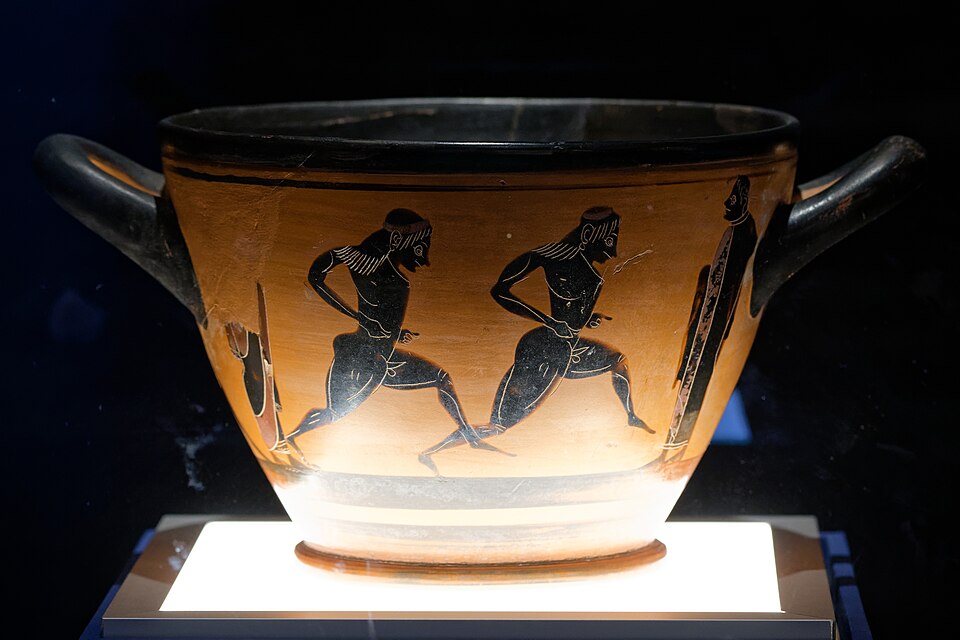
The first games included only running events and were completed in one day. Over the years and centuries, other sports were added and the days increased. The heart of the games was in the stadium, whose track is 192.27 metres long and was a unit of distance measurement, while the slopes of the stadium could accommodate up to 45,000 spectators. The sports were divided into two main categories: a) gymnic games, with the athletes in the stadium being naked and b) equestrian games that took place in the hippodrome. Over the centuries, the sports of the games that were established belonged to 8 main categories. The first and most important were the running events. These included the Stadio (sprint race), the Diavlos (a 1200-foot sprint race), the Dolichos (an endurance race) and the Hoplites (a sprint race of 2 to 4 stadiums, with the athletes wearing armor). The second category was the long jump, which was held in a pit with a platform and sand and the athlete did not run to gain speed, but he gained momentum by using his hands while holding dumbbells. The third category was the javelin throw, which was divided into the ekivolos (i.e. free throw, as is the case to this day) and the stochastic, i.e. with a defined target, in which mounted javelin throwers were usually involved. From 688 BC, the sports of boxing were introduced (for adults, children and according to physical category), which are quite reminiscent of modern boxing. The fifth category of sports was that of wrestling (from 708 BC), which was again divided into adult, children and based on physical condition. A separate sport was the pankration, an extremely violent type of boxing with different rules. The pentathlon was also introduced in 708 BC (18th Olympiad) and included the sports of discus, running, jumping, javelin and wrestling. The last category was the equestrian sports, which included 7 events. Weightlifting was not an official event, but it was necessary training for athletes in heavy sports.
The prize for the winners was the kotinos, that is, the wreath of branches from the sacred olive tree outside the temple of Zeus. Statues for the Olympic champions were erected only for those who had three or more victories. Those who violated the rules (e.g. phenomena of corruption and bribery) paid fines or were flogged. With these fines, statues of Zeus (the Zanes) were made and placed in the Kronion of Ancient Olympia.
There were countless Olympic champions over the centuries, however, some have been historical and gained legendary fame. The Elis runner Koroibos is considered the first Olympic champion. An equally famous runner was Orsippus from Megara, who, as he was running with intensity, his belt broke and the cloth covering his genitals fell off. He continued undaunted, in order not to lose and indeed won. From then on, the games became nude, since only men were allowed to be spectators. The wrestler Hipposthenes from Sparta won 6 Olympic wreathes and was active for 6 Olympiads (24 years). Other legendary Olympic champions were Philobrotus from Sparta in the pentathlon, Milon of Croton in wrestling, the boxer Glafcus from Karystos, Theagenes from Thasos in boxing and pankration, the dolichos runner Ageus from Argos, the runner Philinus from Kos, the famous boxer Cleitomachus from Thebes, the runner and winner in 3 sports on the same day for 3 Olympiads Leonidas from Rhodes, Polydamas from Scotussa in Thessaly in the pankration, who was also linked with several myths, Arrachion from Phigaleia, who defeated his last opponent in the pankration, although he ultimately died, Alcibiades the Athenian with multiple victories in equestrian competitions and finally the wrestler Amisinas from Barca in Cyrenaica (an area of present-day Libya), who trained with a large bull and was trying to make his head touch the ground.
Olympia did not have magnificent buildings by chance. In addition to the athletic competitions, many other commercial and artistic events were held. Thus, in addition to athletes and coaches, non-athletic personalities also used to attend, such as in 408 BC Gorgias from Leontini in Sicily and in 388 BC Lyssias from Athens, who delivered unique speeches.
What I can't see
The Olympic Games were held in honour of the gods, as well as mythical heroes, such as Heracles and Pelops, the mythical founder of the games. We cannot know exactly when the Olympic Games began or their rules, as athletic competitions began as funerary ones that is, to honour the dead, and evolved into the worship of Zeus and the gods of Olympus. The historical figure, however, who is said to have founded the Olympic Games was King Oxylus and his descendants, culminating in the establishment of the Olympic Truce.
776 BC is not referred as the year the games began, but as the year of recognition, reorganization and establishment with a pan-Hellenic reputation. But how did sports begin? Man used his body, his abilities and his muscular strength to survive. The Greeks systematized these activities through the establishment of rules, which gradually developed the classification of sports, fair play, prizes and punishments. The first athletic competitions are found in the epics of Homer and Hesiod.
The first examples of the importance of competition and fair play are also found in Minoan Crete, with the most popular sports being boxing, wrestling, somersault and tavrokathapsia (a kind of bullfighting without killing the bull). Wrestling, boxing and somersault were Egyptian sports in their early forms. The Minoans developed them, set rules, adorned them with elaborate jewelry and clothing, gave them religious significance and the level became so high that long-term training was necessary. Tavrokathapsia was an evolution of somersault, but much more difficult and dangerous and at the same time the most sacred sport in Crete, just as the bull was a sacred animal.
In the Mycenaean era, many of the sports of Minoan Crete were preserved, but the most popular were those of track and field, boxing and wrestling. The Mycenaeans were the originators of the running and chariot races. The games were held in honour of dead heroes, a custom that the Greeks maintained in the following centuries.
In the imagined reality of modern Greeks, the revival of the Olympic Games symbolized identification with ancient ancestors, whose achievements often acquired legendary fame. In ancient times, the games were instituted for similar reasons, so that Greeks could identify with their ancestors and the Homeric heroes. Other religious pan-Hellenic games, such as the Isthmian, Nemean and Pythian, served the same purpose. The Olympic Games, however, were the occasion for each Greek city to show its piety to the gods and to glorify itself before other cities through its excellent athletes and the events it organized. The games therefore evolved into political competitions with the implementation of a pan-Hellenic idea, namely the unification of the Greek cities through the institution of the Olympic truce and for this reason, their prestige exceeded the Greek world.
On the other hand, the athletes had to be strictly Greek. Foreigners, slaves and Greeks who had committed murder or had violated the truce were prohibited from participating. Nevertheless, foreigners and slaves could watch the games. With the conquest of Greece by the Romans, the rule of Greekness of the athletes weakened, as the games lost their former glory. Back to the previous centuries and when the Olympic champions returned to their city, a part of the walls was demolished in their honour and passed through, while they were showered with flowers. Poets wrote hymns for the Olympic champions, who received honours for their entire lives, often greater than those of eminent warriors. In the event of a draw in the game, the wreath was given to Zeus. But did women ever compete? The Heraia (in honour of Hera) were also held in Olympia, which, according to Pausanias, only virgins participated.
The decline of the Olympic Games began gradually in Roman times, continued in the Byzantine period and the establishment of Christianity, and culminated in their abolition by the Byzantine Emperor Theodosius I. As a result, Ancient Olympia was desolated, destroyed and was discovered centuries later by the German Archaeological Institute.
Bibliography
Mavromataki M., (2002), Ολυμπία και Ολυμπιακοί Αγώνες, από την αρχαιότητα μέχρι σήμερα, [Olympia and the Olympic Games, from antiquity to the present day], General Secretariat of Sports
Kyriakou Z., (2003), Ολυμπιακοί Αγώνες, η γέννηση, η αναβίωση, η επιστροφή, [Olympic Games, the birth, the revival, the return], Dimosiografiki Epitheorisi, Taxideftis
Sotiropoulos V., (d.u.), Θρυλικοί Ολυμπιονίκες, [Legendary Olympians], Alfeios Publications
Location
Timeline
Modern and Contemporary era (1821 - )
Ottoman era (1453- 1821)
Byzantine era (331 AC- 1453)
339 AD The last ancient Olympic Games were held, before they were permanently abolished by Emperor Theodosius I, who was also responsible for the mass destruction of many ancient buildings and monuments, as he considered them symbols of idolatry.
Roman era (30 BC- 330 AC)
Hellenistic era (322- 31 BC)
Classical era (478-323 BC)
472 BC The games’ schedule was extended to five days.
Archaic era (800-479 BC)
776 BC The first recorded Olympic Games. They lasted one day.
680 BC The games’ schedule was extended to two days.
632 BC The games’ schedule was extended to three days.

Share